

PHARMA
& BIOTECH
Insulin is a vital hormone for people living with diabetes and its global demand continues to rise. According to the International Diabetes Federation, 589 million adults lived with diabetes in 2024 and this number is projected to reach 853 million by 2045 (IDF Diabetes Atlas 2025). On the other hand, the World Health Organization highlights that approximately over 4 in 5 or around 80% adults with diabetes in many low- and middle-income countries still struggle with insulin availability and affordability, (WHO Essential Medicines List 2021). These pressures make efficient, scalable and sterile insulin production a public health priority.
Discover in this case study how insulin is produced, why industrialisation became essential, how the production process evolved from animal extraction to recombinant biotechnology and how Boccard supported a leading global insulin manufacturer in enhancing its formulation capacity with reliable clean utilities and full aseptic installation!
What is insulin and how did its production evolve?
What is insulin and why is it essential?
Insulin is a peptide hormone that regulates blood glucose levels. For patients with Type 1 diabetes and many with Type 2 diabetes, it is a life‑saving medicine that must be administered regularly and under strict sterility conditions.
How did insulin use to be obtained?
In the early 20th century insulin was extracted from the pancreases of pigs and cows. This method was widely used for decades and made large scale treatment possible, although it required significant animal tissue and produced insulin that was not always perfectly identical to human insulin. This meant variable purity and higher risk of allergic reactions.
Why did the industry move from animal extraction to biotechnology?
With rising demand and the need for purer insulin, scientists turned to recombinant DNA technology. In 1982 the first recombinant human insulin produced using genetically engineered E. coli was approved by the FDA, marking a turning point in the pharmaceutical industry. Recombinant insulin is chemically identical to human insulin, easier to purify and scalable in industrial bioreactors.
Boccard has also had the opportunity to support an Eastern European company in designing a bioreactor that allows the fermentation of recombinant proteins. Read more about it here.
What Are the Main Stages of Modern Insulin Production today?
Modern insulin manufacturing usually follows one of two biotechnology routes:
- Fermentation of genetically modified E. coli or yeast producing pro‑insulin: an early form of insulin produced inside pancreatic beta cells with an initial single‑chain molecular structure that is later cut and folded into active insulin and its companion peptide
- Recovery, purification and conversion into human insulin or insulin analogues
- Formulation, the stage where purified insulin is stabilised and prepared for aseptic filling
Step 1: How is the recombinant strain created?
Scientists identify and insert the human insulin gene into E. coli or yeast. The modified cells gain the ability to express pro‑insulin or an insulin precursor. This gene insertion is validated for productivity, stability and safety before scale up.
Step 2: How is fermentation conducted?
The recombinant microorganism is cultivated in stainless steel bioreactors. Inside these vessels operators carefully regulate:
- Temperature
- pH
- Dissolved oxygenb
- Nutrients feeding strategy
The goal is to maximise biomass growth and pro‑insulin expression while preserving product integrity.
Step 3: How is insulin precursor harvested?
Once fermentation is complete, the culture is transferred to downstream operations. Depending on the microorganism used:
- E. coli requires cell disruption to release the insulin precursor
- Yeast secretes insulin precursors more readily
Harvest steps include centrifugation and filtration to remove unwanted solids.
Step 4: How is insulin purified?
Purification may include:
- Solubilisation of inclusion bodies (in E. coli processes)
- Precipitation to remove impurities
- Multiple chromatography steps to isolate the insulin precursor
- Ultrafiltration to concentrate the product
The goal is to achieve pharmaceutical‑grade purity suitable for injection.
Step 5: How is insulin converted into its final form?
When the precursor is purified it undergoes enzymatic or chemical conversion to produce:
- Human insulin
- Rapid‑acting analogues
- Long‑acting analogues
Each type requires precise reaction conditions and careful monitoring.
Step 6: What happens during insulin formulation?
Purified insulin is mixed with:
- Buffers
- Preservatives
- Stabilising excipients
These allow the final medicine to remain effective and safe throughout its shelf life. This step is highly sensitive to contamination and requires flawless utilities such as (water for injection) WFI, pure steam and pharmaceutical‑grade compressed air.
Step 7: How is the final product filled and sealed?
The formulated solution is transferred through sterile piping to filling lines. The product is then:
- Filled into vials, cartridges or pens
- Inspected
- Labelled
- Packed for distribution
All steps take place in a controlled cleanroom with validated cleaning cycles and traceability.
Understanding each step makes it clear why formulation workshops and clean utilities are central to insulin quality. The formulation stage is where the bulk product becomes a stable, injectable medicine that patients depend on. Boccard’s work strengthens this critical stage by ensuring sterility, utility performance and process reliability.
What are the key constraints in industrial insulin production?
Insulin must be produced in a sterile environment with strict control of temperature, pH and excipients. Facilities must comply with GMP, FDA or EMA standards. Reliable Water for Injection (WFI), pure steam and purified water networks are essential to guarantee the sterility of the final drug product.
Why Does the World Face Challenges in Insulin Availability?
The IDF and WHO report steady increases in diabetes prevalence. Many health systems struggle with cost constraints and supply chain pressures that impact local insulin production or importation.
What operational pressures do insulin manufacturers face?
Manufacturers must expand capacity, maintain sterility, keep costs under control and handle growing complexity in insulin analogues. They must also deploy solutions that scale quickly with limited downtime.
How Did Boccard Support a Leading Global Producer With Its Insulin Formulation Workshop?
Boccard has worked with a major European insulin manufacturer who selected Boccard to reinforce its formulation capacity at its French site. The client needed to scale up production volumes to match rising worldwide demand while preserving aseptic reliability and meeting strict GMP expectations. The existing formulation area required larger sterile storage capabilities, stable clean utilities and a fully integrated installation approach that would not disrupt ongoing operations.
Boccard began by assessing the site’s formulation workflow and identifying where utility performance, thermal stability and hygienic design would be most critical. The client needed high quality tanks that could support full vacuum and pressure variations, along with clean utility loops designed to supply continuous WFI, purified water and pure steam to sustain safe and repeatable formulation campaigns. Boccard ensured that all equipment, piping and utilities were designed and integrated to maintain sterility and operational continuity while securing long term production growth.
To meet these needs Boccard engineered and installed:
- 2 complementary WFI loops dedicated to formulation
- 1 purified water loop for feeding the process
- Pure steam and compressed air networks supporting aseptic operations: these networks were routed and dimensioned to ensure thermal stability and reduce any risk of contamination.
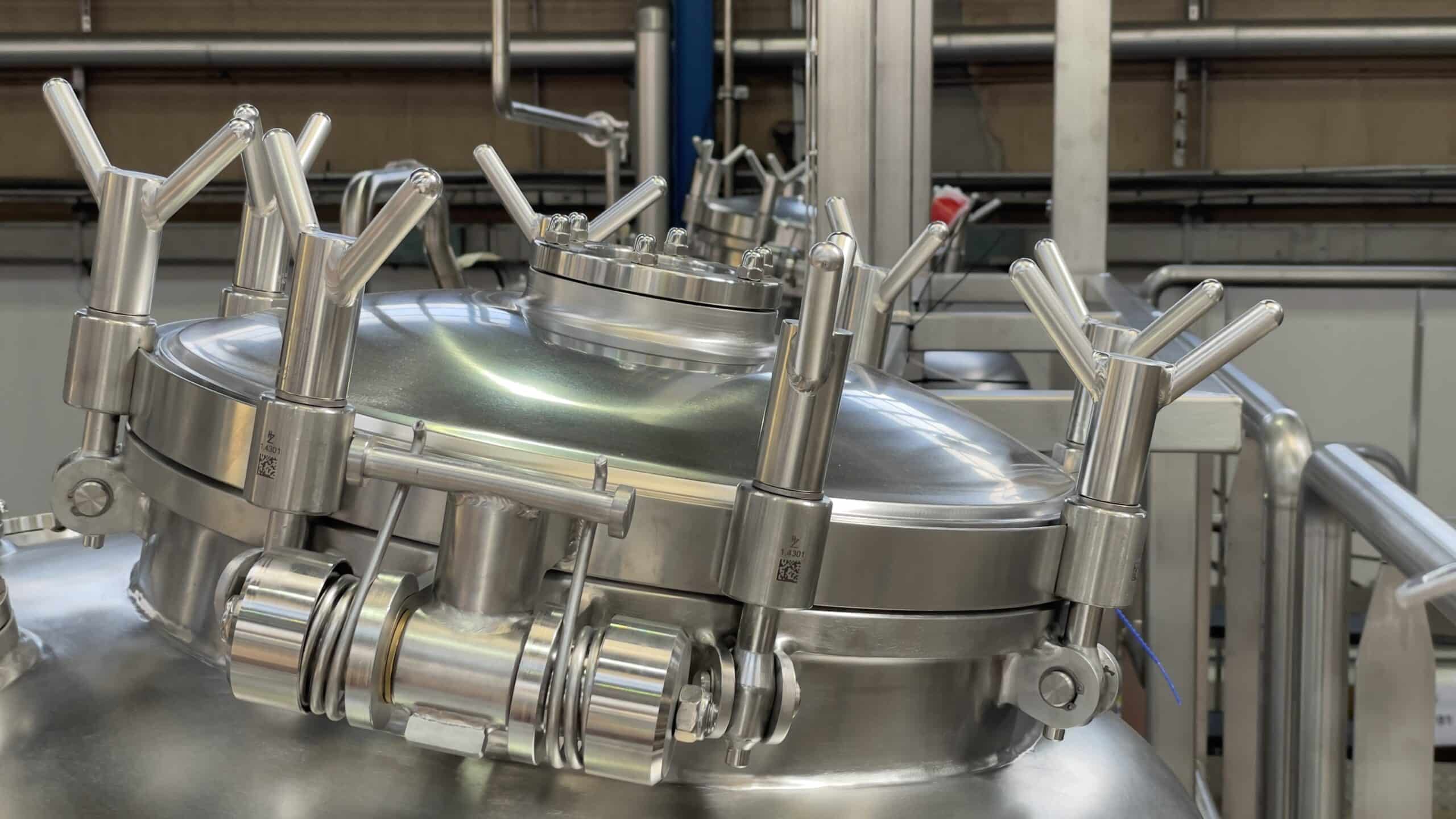
- 2 large capacity formulation tanks of 8000 L and 14000 L, designed for 5 bar pressure and full vacuum, with internal polishing to Ra < 0.8 µm for sterile conditions and external finishing to Ra < 1.2 µm. Their size, finish and mechanical properties ensured compatibility with high purity hormonal products.
Process integration required careful planning. New piping was installed with hygienic slopes and drainability principles applied everywhere. Equipment was tested, qualified and linked to existing control systems to deliver a seamless, fully validated environment for formulation activities. Validation steps included FAT, SAT, IQ and OQ, ensuring full traceability and compliance with regulatory expectations.
Learn more about our solutions for
fermentation and Pharma & Biotech?
Key points
High capacity formulation tanks: 8000 L & 14000 L, full vacuum and 3.5 bar capability with sterile internal finish Ra < 0.8 µm, external finish Ra < 1.2 µm
Dual WFI loops engineered for continuous aseptic supply of purified water through pure steam networks integrated into the existing plant layout
Clean piping installed with hygienic slopes, drainability and aseptic routing with utility stability improved through redesigned thermal and circulation architecture
Full operational continuity maintained during installation and complete qualification sequence: FAT, SAT, IQ, OQ
scope of work, EQUIPMENT AND SERVICES SUPPLIED
- Engineering & prefabrication: detailed 3D design of the formulation area, clean utilities engineering including WFI loops, PW loops, and pure steam, mechanical design of high-capacity tanks, and prefabrication of hygienic piping and support structures
- Utilities & hygienic design: installation of two WFI distribution loops, installation of a new purified water loop for formulation, integration of pure steam and compressed air networks, and construction of hygienic piping designed for drainability, thermal stability, and aseptic integrity
- Equipment supply and integration: the equipment supplied and integrated includes 8,000 L and 14,000 L formulation tanks, hygienic fittings and valves, utility manifolds and distribution panels, as well as connections to existing plant utilities with minimal downtime
- Qualification and commissioning: FAT and SAT were executed on all tanks and utilities, IQ and OQ documentation and execution ensured full traceability, thermal and sterilization cycle validation was performed, and operator training and hand-over support were provided.
You have a project ?
Our Customers
They trust us