



PHARMA
& BIOTECH
Immunoglobulins are essential therapies derived from human plasma used across a range of rare autoimmune diseases, and their clinical importance is increasing while global supply remains under pressure. The European Medicines Agency continues to report an ongoing shortage of human immunoglobulins, and the global immunoglobulin market according to Vox Sanguinis is projected to grow from $13.36 billion in 2023 to $24.98 billion by 2032, while many countries remain dependent on imported plasma supply. These therapies are used in rare diseases such as myasthenia gravis, a rare autoimmune neuromuscular disease causing fluctuating muscle weakness, CIDP, a rare autoimmune neuropathy affecting peripheral nerves, and Guillain Barré syndrome, a rare autoimmune disorder that can lead to rapid paralysis.
In response to this growing medical and industrial need, Boccard assists pharmaceutical manufacturers by designing and delivering industrial‑scale immunoglobulin production facilities based on the blood plasma fractionation process, supported by proven expertise in Pharma & Biotech process engineering and facility integration. Discover how Boccard helped one of these clients in North America build a robust and scalable blood plasma fractionation plant designed to support long‑term immunoglobulin production needs!
Why Are Immunoglobulins Strategic for Rare Autoimmune Diseases?
What are immunoglobulins and where are they used?
Intravenous immunoglobulins, often referred to as IVIg, are highly purified IgG antibodies, or Immunoglobulin G, the most common type of antibody found in the blood, obtained from pooled human plasma. They are used both in immune deficiencies and in autoimmune disorders where regulation of the immune system is required to reduce harmful antibody activity and inflammatory responses.
According to the American Association of Neuromuscular & Electrodiagnostic Medicine (AANEM), IVIg is recommended for CIDP, Guillain Barré syndrome in adults, multifocal motor neuropathy and myasthenia gravis exacerbations, while older manufacturing literature also identifies immune thrombocytopenic purpura as one of the important autoimmune uses of IVIg.
This gives immunoglobulins a unique position in rare disease care. They support several disorders at once, which means manufacturing investment is driven by cumulative clinical need across neurology, immunology and haematology.
Why is demand for immunoglobulins increasing?
Demand for Immunoglobulins is increasing for two main reasons:
- More patients are being identified: a 2024 systematic review in Neuroepidemiology found that the prevalence and incidence of myasthenia gravis have significantly increased worldwide in recent years, probably due to improved epidemiological methods and advances in diagnosis.
- Immunoglobulins are used across a broad and expanding therapeutic base while supply remains constrained: The European Medicines Agency has already warned that shortages of human normal immunoglobulins are affecting multiple Member States, and the 2025 Vox Sanguinis review states that immunoglobulin manufacturing typically takes 7 to 12 months, much longer than many conventional biologics.
The result is a structural tension between medical need and industrial capacity. For manufacturers, this means investment decisions must increasingly focus on scalable fractionation, robust purification and reliable viral safety. For engineering partners, this translates into delivering facilities that can process large plasma volumes while maintaining product integrity, traceability and GMP compliance.
How Are Immunoglobulins Produced at Industrial Scale?
What are the main stages of immunoglobulin manufacturing?
Modern immunoglobulin production starts with pooled human plasma of thousands of donors, typically relying on between 10 000 and 50 000 donations. The industrial backbone remains cold ethanol fractionation, often referred to as the Cohn process, then chromatographic methods are used to improve purity. IgG demand is one of the factors determining how plasma fractionation capacity is designed.
In practical terms, industrial immunoglobulin manufacturing includes:
- Pooled human plasma as the starting material.
- Fractionation based on cold ethanol precipitation.
- Additional purification steps, including chromatography.
- Viral safety procedures designed to eliminate pathogens.
Newer, state-of-the-art manufacturing processes rely on virus elimination procedures grouped into three classes: partitioning, inactivation and virus filtration.
Why are blood fractionation facilities so industrially demanding?
Blood plasma fractionation combines large volume protein handling with solvent management, purification accuracy and extremely high expectations for viral safety. Fractionation facilities often need to integrate chromatography skids, ultrafiltration, nanofiltration, buffer preparation, CIP systems, WFI loops and advanced automation within a single validated environment.
That industrial complexity is visible in Boccard’s own plasma fractionation references, which include multi-building sites, clean rooms, protein purification skids, nanofiltration modules, extensive utility networks and large volumes of qualification documentation.
Boccard builds immunoglobulin production facilities supplying therapies used in rare autoimmune diseases such as myasthenia gravis. The contribution is made at the product platform level through the design, construction and qualification of blood plasma fractionation plants that manufacture immunoglobulins used across multiple autoimmune indications.
Why Must Immunoglobulin Production Capacity Expand Now?
How do immunoglobulin shortages and disease trends shape the market?
The immunoglobulin market is growing, but the supply base remains fragile. The 2025 Vox Sanguinis review states that many countries are not self-sufficient in plasma and rely heavily on the United States, which supplies around 70% of the world’s plasma. The same review highlights growing demand, manufacturing complexity and the persistence of shortages despite market growth. The European Medicines Agency confirms that supply shortages are real and ongoing in Europe.
At the disease level, rising diagnosed prevalence in conditions such as myasthenia gravis reinforces long term treatment demand. At the policy level, regulators are also supporting the development of therapies for rare diseases more actively, which strengthens the broader orphan and specialty drug environment. From an industrial point of view, this combination supports further investment in fractionation capacity, protein purification infrastructure and specialist manufacturing platforms.
Why does this matter for pharma manufacturers and CDMOs?
For plasma fractionators, biopharma manufacturers and specialist CDMOs, facilities must become more scalable, more reliable and more efficient without compromising safety. Product demand can rise faster than manufacturing output because plasma is human derived and the production cycle is long. That creates a strategic premium on facilities that can combine purification performance, clean utilities, flexible skids and qualification readiness from day one.
Blood fractionation remains a strategic field in Pharma & Biotech. It sits at the intersection of rare disease care, biological manufacturing and supply resilience. For countries and companies seeking stronger autonomy in plasma derived medicines, investment in fractionation infrastructure is becoming a strategic requirement.
How Did Boccard Support a Major Plasma Fractionation Project in North America?
Boccard’s major plasma fractionation project in North America is a strong example of this industrial reality. Following the decision to invest in a new blood fractionation plant dedicated to plasma‑derived products, Boccard supported one of the biggest blood fractionation projects in North America at the time of construction. The client specialises in the development and production of products derived from plasma, recombinant proteins and therapeutic antibodies. The facility was designed for a production capacity of 1 million litres of plasma per year and included a new 10,000 m² factory built on a 63,000 m² greenfield.
Boccard was selected as supplier for the biopharmaceutical equipment of this flagship project and supported the design and construction of key equipment together with Canadian, French and American teams. The delivered scope covered equipment for an intravenous immunoglobulin (IVIg) and albumin plant, including the manufacture and installation of 3 purification batches and 1 formulation batch. The reference also states that Boccard committed to the design and manufacture of key equipment for the biggest blood fractionation plant in the country to date, with an ambitious 18‑month schedule.
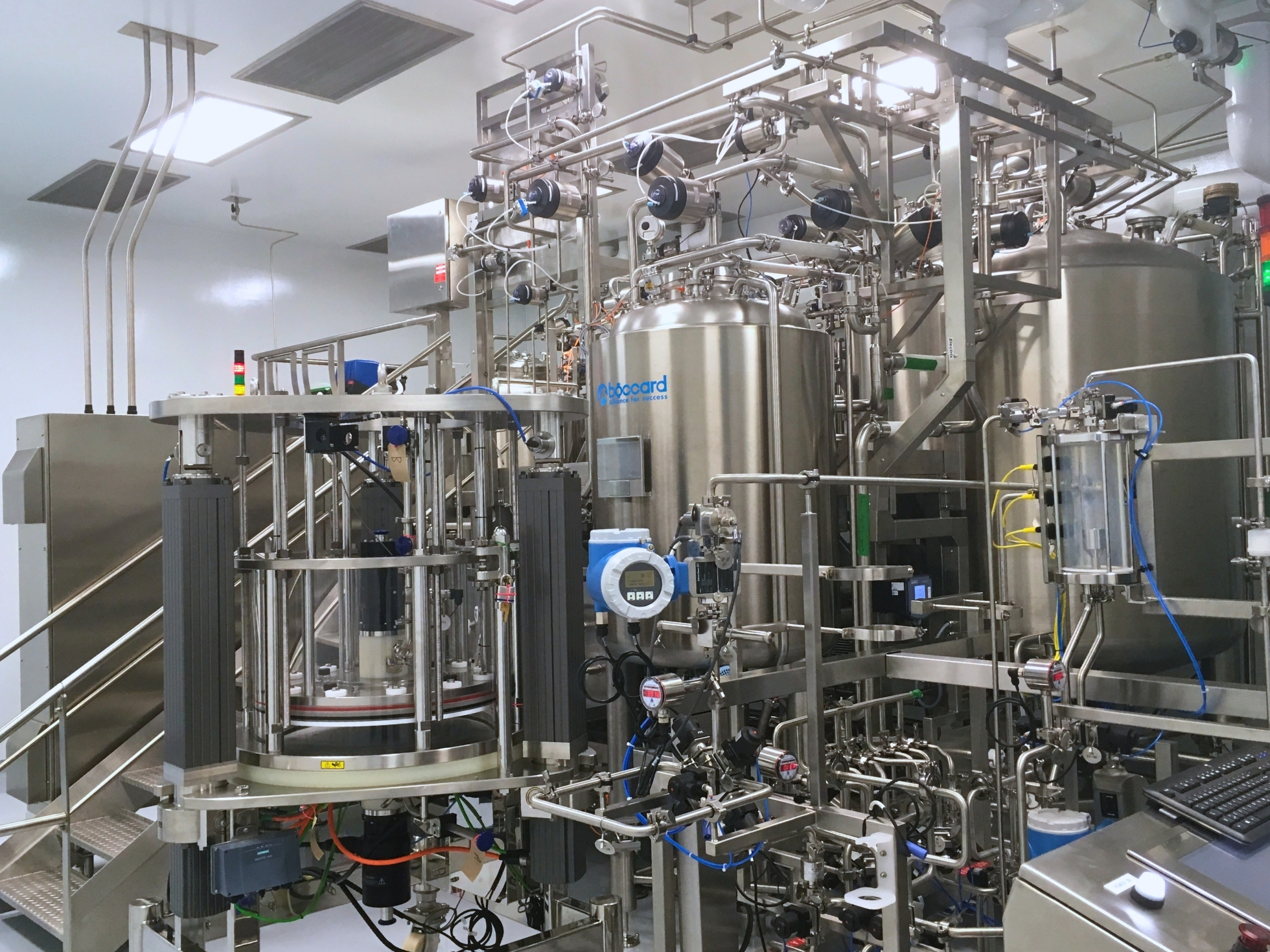
The plant was engineered to support a large and integrated process architecture:
- 24 skids
- 30 tanks
- 3 purification batches and 1 formulation batch
- Process intelligence with 17 controllers / automatons and 30 electrical cabinets
- Automation and technical documentation integrated into the delivered package
It was also a major project for a North American plasma‑derived medicines platform. Boccard’s role included engineering, procurement, construction, commissioning, qualification and training. The reference highlights the overall scale of execution with 63,000 hours of engineering, commissioning and qualification, reflecting the level of technical coordination required for a project of this size and strategic importance.
Want to learn more about our solutions for
Pharma & Biotech?
Key points
Blood plasma fractionation remains a strategic manufacturing field for plasma derived therapies, including immunoglobulins used in rare autoimmune diseases.
Boccard supported one of the biggest blood fractionation projects in North America at the time of construction. The project was designed for 1 million litres of plasma per year and the facility covered a new 10,000 m² factory developed on a 63,000 m² greenfield site in North America.
The delivered scope supported IVIg and albumin production through 3 purification batches and 1 formulation batch, and the installation included 24 skids, 30 tanks, 17 controllers / automatons and 30 electrical cabinets.
The execution required 63,000 hours of engineering, commissioning and qualification.
scope of work, EQUIPMENT AND SERVICES SUPPLIED
- Engineering & prefabrication: Design and manufacture of key biopharmaceutical equipment for a new blood fractionation plant, engineering support for 3 purification batches and 1 formulation batch dedicated to IVIg and albumin production, technical documentation developed as part of the delivered scope.
- Utilities & hygienic design: Process intelligence integrated through 17 controllers / automatons and 30 electrical cabinets, automation architecture delivered as part of the plant equipment package, integration support provided through coordinated Canadian, French and American teams.
- Equipment supply and integration: Delivery and installation of 24 skids, delivery and installation of 30 tanks, supply of key biopharmaceutical equipment for IVIg and albumin production.
- Qualification and commissioning: Engineering, commissioning and qualification effort representing 63,000 hours overall, qualification activities including validation tests, IQ and OQ, training delivered as part of the final project scope.
You have a project ?
Our Customers
They trust us