

PHARMA
& BIOTECH
Driven by the rise of obesity and Type 2 diabetes worldwide, the GLP‑1 (known as Glucagon-Like Peptide-1) market has become one of the fastest‑growing segments in the pharmaceutical industry according to the WHO Global Obesity Facts in 2025. Demand for GLP‑1 analogues is expanding sharply as these molecules demonstrate efficacy in glycemic control and weight management, pushing the biggest pharmaceutical manufacturers to increase capacity rapidly and securely. This acceleration has created a new challenge for production sites: deploy industrial infrastructure that supports reliable scale up, ensures regulatory compliance and maintains the highest quality standards required for peptide therapeutics.
Discover in this article how Boccard supported its client in achieving their goal of building a robust and scalable GLP‑1 production line!
Why do GLP-1 Therapies Require Industrial Scale Manufacturing Solutions?
What makes GLP-1 a strategic molecule today?
GLP‑1 receptor agonists are peptide‑based drugs that stimulate insulin secretion, regulate appetite and contribute to weight reduction. Their clinical adoption has grown rapidly, positioning GLP‑1 as a cornerstone in modern diabetes and obesity care. As a result, manufacturers must expand production lines capable of handling complex purification steps, controlled environments and strict aseptic requirements.
Boccard has also had the opportunity to support a major European insulin manufacturer in 2004 in reinforcing its French formulation capacity by providing high-capacity formulation tanks and WFI loops. Read more about it here.
What are the key industrial constraints in GLP-1 production?
GLP‑1 molecules require precise upstream and downstream processing, high‑purity raw materials and stringent hygienic design. Large volumes of buffer preparation, chromatography operations and clean utility availability must be coordinated to maintain consistency. To deliver reliable production the installation must combine flexibility, contamination control and validated equipment that can be integrated without disrupting existing operations.
How Is GLP-1 Produced at Industrial Scale?
While processes vary by manufacturer, modern GLP‑1 production typically includes different stages:
- Synthesis or fermentation of the peptide or precursor
- Purification, often relying on several chromatography steps to reach pharmaceutical‑grade purity
- Buffer preparation and intermediate storage, requiring tightly-controlled vessels
- Formulation, where the purified peptide is stabilised for filling
- Final filling and packaging in fully aseptic environments
Each stage depends on robust utilities such as purified water, WFI, pure steam and clean compressed air. The installation must ensure thermal stability, hygiene, traceability and repeatability.
How did Boccard Support its Client in Deploying a New GLP-1 Production Line?
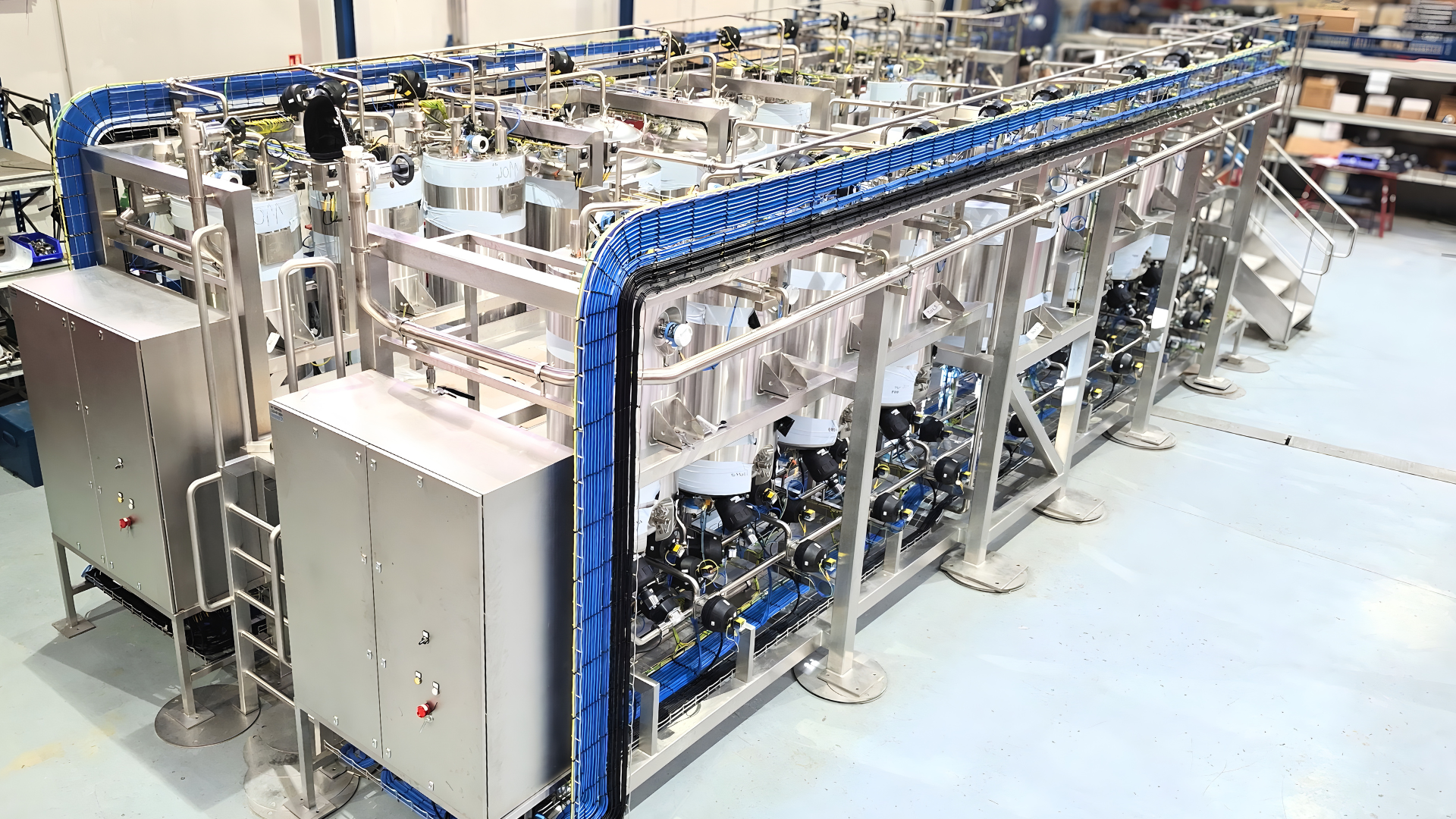
In 2025 Boccard partnered with a pharmaceutical manufacturer to design and deliver a complete GLP‑1 production installation supporting the client’s expansion plan. The objective was clear: to increase production capacity through a fast‑track project while ensuring full GMP and FDA alignment.
The scope included:
- 19 new skids and modules
- 5 skids fully revamped
- 2 super‑skids dedicated to chromatography harvesting
- A complete tank farm with:
- 30 vessels @ 200 L
- 6 vessels @ 500 L
- 6 large vessels ranging from 1000 to 10000 L
- 1 vessel @ 250 L
- 13 vessels reused and integrated into the new design
The project required more than 9000 hours of engineering, combining modular fabrication, hygienic design and sequencing constraints. Boccard delivered the first super‑skid fully wired and tested within only ten months of launch, enabling a rapid transition to qualification.
What Was the Project Timeline?
The schedule followed two key acceptance phases:
- February 2025 – Project launch
- February 2026 – Acceptance 1 (86%), followed by an additional ten‑week period for testing and adjustments
- May 2026 – Acceptance 2 (14%), followed by the final ten‑week window before full delivery
These periods covered FAT, integration work, documentation finalisation and site readiness to ensure seamless transition to commissioning activities.
HOW DOES BOCCARD deliver fully integrated and qualified glp-1 installation?
Boccard engineered, fabricated and integrated all skids, super‑skids and tanks in compliance with GMP requirements for peptide production. The design ensured:
- Cleanability and drainability across all piping
- Full instrumentation and automation ready for recipe management and process repeatability
- Efficient flow between buffer preparation, purification and intermediate storage
- Optimised footprint and ergonomics to fit the client’s facility constraints
- A complete set of qualification protocols including FAT, SAT, IQ and OQ
This integrated approach ensured process reliability, reduced installation risks and accelerated the client’s readiness for commercial manufacturing.
Learn more about our solutions for
fermentation and Pharma & Biotech?
Key points
2 chromatography Super skids delivered in fast-track mode
19 new skids and 5 revamped modules, including 43 new vessels plus 13 reused vessels integrated into the new line
From more than 9000 engineering hours to reach accelerated milestones to qualification readiness through FAT, SAT, IQ and OQ
Modular design supporting fast installation and limited disruption, as well as full hygienic and GMP aligned fabrication for peptide processing
scope of work, EQUIPMENT AND SERVICES SUPPLIED
- Engineering & prefabrication: 3D design of the full GLP‑1 process line, modular skid engineering including upstream buffer preparation and downstream purification, tank farm design for vessels from 200 L to 10000 L, prefabrication of hygienic piping and structural modules
- Utilities & hygienic design: integration of purified water, WFI and pure steam, clean compressed air and utility distribution panels, fully hygienic piping ensuring thermal stability and reliable cleaning cycles
- Equipment supply and integration: delivery of super‑skids and process skids fully wired and tested, assembly of all vessels, manifolds and connection points, integration of reused equipment with updated instrumentation
- Qualification and commissioning: FAT and SAT completed on skids, super‑skids and vessels IQ and OQ documentation with traceability, support during commissioning and handover to operations teams
You have a project ?
Our Customers
They trust us