


PHARMA
& BIOTECH
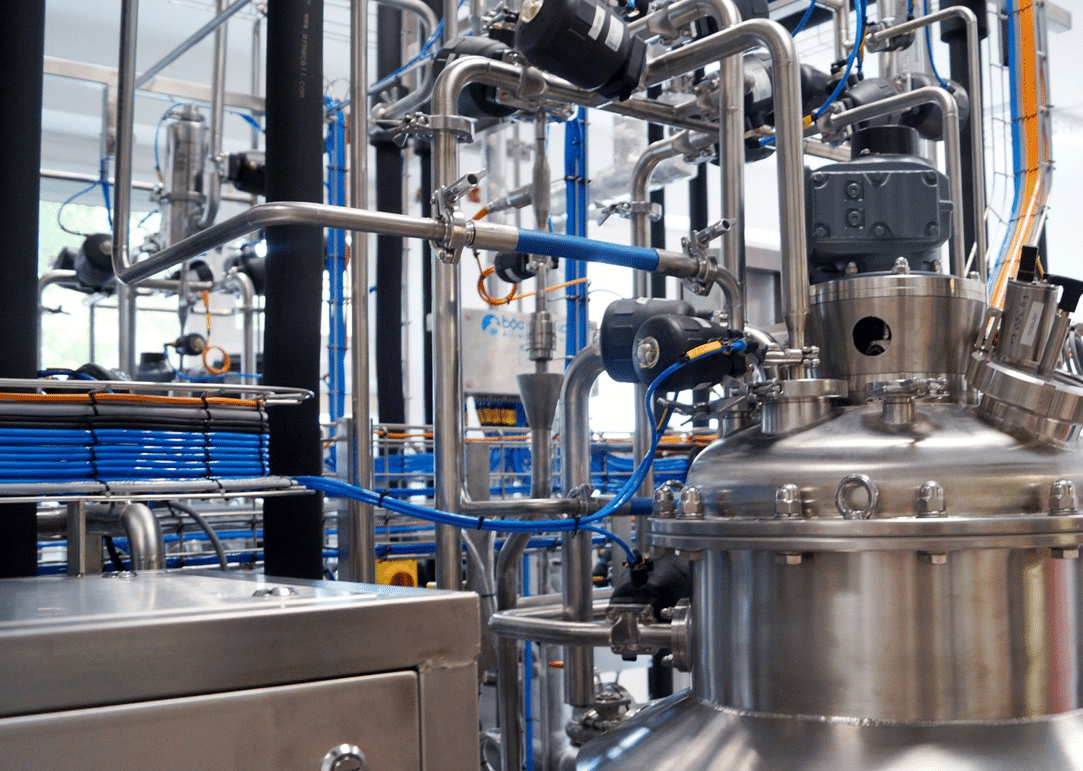
Escherichia coli fermentation for recombinant protein production has had a significant role in modern biotechnology for decades and is now routinely standardised in bioreactors to ensure repeatability and scale-up. Such as the case of this European institute investing in a propagation line from small 5-liter glass bioreactors to a 30 L second seed, then to 150 L main bioreactor. The process integrates inline pH/DO (dissolved oxygen)/glucose analytics, CIP/SIP, downstream processing with compact centrifuge, sonication and ultrafiltration and a waste inactivation tank (pH/temperature controlled), all inside a constrained, office-type space. The aim: reproducible upstream control and clean handoff to downstream. Discover how Boccard supported this company in fulfilling their objectives!
What is the history behind E. coli and recombinant protein fermentation?
Historically, recombinant DNA methods with E. coli led to human insulin, the first FDA approved recombinant drug human insulin in 1982. This was a milestone that opened the modern era of biopharmaceuticals and proved that engineered bacteria could safely manufacture human proteins at scale.
Today, genetically modified E. coli are used to produce human growth hormone, interferon‑α2b (for chronic hepatitis and certain cancers), interleukin‑2 (for immunotherapy of metastatic renal cell carcinoma and melanoma) and a range of therapeutic/industrial enzymes: L‑asparaginase for acute lymphoblastic leukemia, various biocatalysts for manufacturing.
What does “fermentation” cover here: Upstream vs. Downstream?
Upstream fermentation: inoculum expansion (seed train), in this case the genetically modified E. coli and production in stirred‑tank bioreactors with control of pH/DO (dissolved oxygen)/temperature, aeration, mixing and feeds, plus induction strategy. This produces biomass and the target protein inside (or sometimes secreted by) the E. coli cells.
Downstream starts after the run stops:
- Centrifugation to harvest the product using mechanical density separation
- Sonication for lysis or breaking cell walls for intracellular/periplasmic products, meaning proteins synthesised within the cells of the biomass
- Ultrafiltration to concentrate and clarify before chromatographic purification.
What are the challenges when moving from glass to industrial bioreactors?
Scaling-up from glassware to 30 and 150 L bioreactors is not simply a question of “just bigger volumes”. This is because hydrodynamics, mass/heat transfer and sterility assurance fundamentally change.
Sterilisation mode evolves from autoclave to SIP:
At 5 L, vessels and lines especially in glass are typically sterilised in an autoclave (ex situ). At 30 L and 150 L, stainless steel reactors are sterilised in place using steam through the thermal jacket and associated piping. This shift requires automated sequences, precise steam control, validated hold times and full coverage of probes, filters and connections to assure asepsis of the entire flow path.
Loss of visual approach of running fermentation:
In glass, operators rely on direct visual cues. In stainless, you depend more on instrumentation and data: pH, dissolved oxygen and glucose analytics, temperature, pressure and gas flows underpin decisionmaking during seed buildup, induction and harvest. Batch overlays, alarms and historian trends replace lineofsight checks and help maintain repeatability run after run.
Thermal management becomes a control problem and not only a setpoint:
Larger stainless steel vessels have higher thermal inertia. Double jacket circuits, utility capacity and tuned control loops must handle metabolic heat during growth and the thermal shocks of induction, CIP and SIP without overshoot. The goal is a stable thermal profile that protects product quality and keeps cycle times under control.
Gas transfer and mixing must be re-engineered:
Impeller type, sparger geometry, gas blend, back pressure and antifoam strategy are sized for a given oxygen transfer rate (OTR) and homogenisation at scale. Expertise in mixing engineering is needed to achieve the objective of matching oxygen uptake, avoiding gradients and managing shear so cells see the same environment at 150 L that delivered results at 5 L.
Hygienic design, CIP and waste inactivation become part of the process:
Scale introduces cleanability and compliance constraints: drainable layouts, validated CIP sequences and closed transfers reduce contamination risk. Where genetically modified organisms or biosafety concerns exist, a dedicated waste inactivation tank with temperature and pH control provides an auditable barrier before discharge.
Automation and ergonomics matter in real spaces:
Moving from a benchtop to an office‑type room means building a compact line that still allows safe access, clear utilities and easy operation. Automated recipes simplify routine tasks and reduce operator variability while preserving flexibility for R&D.
How did Boccard support the client in upgrading their recombinant proteins process?
Boccard engineered and delivered a 30 L seed (pH/DO/glucose) feeding a 150 L main bioreactor; integrated centrifuge, sonication and ultrafiltration for compact pilot scale recovery; and installed a waste inactivation system (temperature + pH). The skid and utilities were adapted to a small, office-type room, with CIP/SIP and automation for repeatable runs.
In short, Boccard was challenged to build a fermentation line compliant with environmental and safety guidelines related to waste inactivation, that respects ergonomic installation despite restricted premises and versatile and easy-to-handle automation. These were the clients’ expectations Boccard managed to fulfill.
Which Boccard bioreactors support fermentation and scale up beyond pilot?
The same pillars are standard in TEKINBIO™, Boccard’s bioreactor for fermentation and scale‑up, with Track Advance as the digital backbone for real‑time monitoring, recipe governance, and lot‑to‑lot comparison: a practical, auditable bridge from pilot to industrial.
TEKINBIO™ integrates:
- Optimized aeration: sparger geometry, headspace pressure, O₂ transfer
- Engineered mixing: CFD validated homogenization and shear control
- Precise thermal control
- Hygienic design with CIP/SIP
- Track Advance for recipes, batch comparison and compliance support
Learn more about our solutions for
fermentation and Pharma & Biotech?
Key points
Two reactor line: 30 L seed (pH/DO/glucose) → 150 L main; CIP/SIP; compact DS modules (centrifuge, sonication, UF)
Waste inactivation: dedicated tank with temperature & pH control prior to sewer discharge
Room constraint solved: integration in office type space with adapted utilities and ergonomics
Scale up guardrails: seedtrain documentation, OTR/mixing design, thermal capacity, asepsis, and recipe traceability
scope of work, EQUIPMENT AND SERVICES SUPPLIED
- Engineering & prefabrication: Design and fabrication of a 30 L + 150 L bioreactor train with inline analytics, integrated DS units (centrifuge, sonication, UF), control cabinets, and modular piping built for compact rooms and ease of installation.
- Utilities & hygienic design: Preparation for CIP/SIP, steam, gases, and process‑water connections; hygienic layout for asepsis and repeatability; thermal utilities (steam generator/chiller).
- Process enablement (recombinant protein campaigns): Support for seed‑to‑main fermentation (e.g., 5 L glass to 30 L to 150 L), induction strategy, and operating windows (pH/DO/temp/OTR, agitation), with documentation for robust batch comparisons and DS hand‑off
- Path to industrialisation with TEKINBIO™ and Track Advance: Transfer pilot learnings into TEKINBIO™, paired with Track Advance for real‑time monitoring, recipe governance, lot‑to‑lot analytics, and regulatory traceability as a proven path from pilot to industrial.
You have a project ?
Our Customers
They trust us