


FOOD
& INGREDIENTS
Fermentation in stirred-tank bioreactors is a proven way to make lactic acid for the food and ingredients market. In this project, an industrial company is establishing a lactic acid fermentation line that uses lactic acid bacteria such as Lactobacillus to convert carbohydrate sources including molasses, glucose syrups, starch hydrolysates and whey permeate into a consistent food ingredient. This was the first lactic acid production facility from micro-organism in the country converting organic substrates to environmentally friendly products. The objective is a repeatable, data driven process that is ready for scale up and compliant with food grade requirements. Discover how Boccard supported this company in fulfilling their objectives!
What is the use of lactic acid in food & ingredients production?
Lactic acid is a widely used food ingredient that regulates pH, sharpens flavour and contributes to microbial stability across beverages, sauces, bakery and meat processing. In the EU, lactic acid is listed as E270 in the food additive numbering system. In the US, lactic acid is affirmed GRAS (Generally Recognised As Safe), which means experts agree it is safe under the conditions of intended use and it may be used in foods following current good manufacturing practice. Commercial food‑grade production commonly relies on fermentation of carbohydrates.
What other diverse use of lactic acid in the food & ingredients industry?
Beyond direct food uses, lactic acid is the monomer used to make polylactic acid (PLA). PLA is a biobased polymer applied in food contact packaging such as films, trays and bottles and in other consumer articles. It offers compostability under defined conditions and can be blended or compounded to improve thermal and barrier properties for specific packaging formats.
How does fermentation produce lactic acid from carbohydrate feeds?
Lactic acid is produced by bacteria or fungi, with bacterial fermentation being a major method. Key strains include E. coli, Corynebacterium glutamicum and Bacillus species. A common challenge is the acidification of the culture medium, as accumulating lactic acid lowers pH and becomes toxic at high levels. Rigourous pH control and continuous fermentation are essential for optimal yield, which are areas where TEKINBIO™ offers valuable solutions.
What are the control levers and parameters to master to produce lactic acid by fermentation?
- pH & neutralisation: Lactic acid production rapidly lowers pH, so accurate base addition and control algorithms protect rate and product profile.
- Carbon strategy & feeds: Variability in molasses and other carbohydrate sources requires characterisation and feed control to manage yield and by‑products.
- OTR and mixing: Even at low‑DO operation, adequate oxygen transfer capacity and homogenisation prevent hotspots, viscosity gradients and stalled fermentations.
- Thermal regulation: Exothermic phases demand responsive cooling to avoid drift in rate or impurity formation.
- Sterility & hygienic design: Repeatable CIP/SIP and aseptic integrity guard food‑grade status and minimise rework.
How does Boccard enable fermentation and scale-up for lactic acid production?
To move from lab to pilot scale with confidence, Boccard engineered the upstream line for repeatability and data integrity:
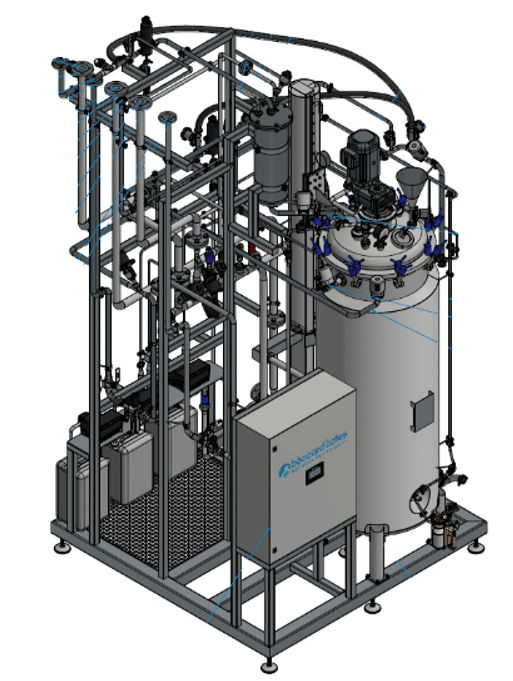
- Ready‑to‑connect pilot skids: Two complete skids with 50 L and 300 L bioreactors, a control cabinet, gas filtration and feeding, a dosing pump and all necessary piping on a common frame with adjustable feet. Prepared for connection to external utilities.
- Seed to production: Robust inoculum management and a scalable agitation and gassing strategy maintain physiology and productivity across vessel sizes.
- Process analytics: Inline pH and dissolved oxygen with batch overlays to detect carbon or oxygen limitations early and to tune feed, neutralisation and temperature profiles.
- Hygienic and utility design: Validated CIP/SIP, steam, gases and clean‑air management support food‑grade operation. Where required, thermal and/or pH waste inactivation is included before discharge.
- Digital traceability: Recipe governance and lot‑to‑lot comparison reduce scale‑up risk and accelerate tech transfer.
What is Boccard’s technical solution for lactic acid production by fermentation?
The capabilities required for lactic acid are standard in TEKINBIO™, Boccard’s bioreactor for fermentation and scale up, with Track Advance providing real-time monitoring, recipe governance and batch comparison. This combination gives a practical bridge from pilot to industrial for food and ingredients.
TEKINBIO™ integrates:
- Optimised aeration and mass transfer,
- Engineered mixing with CFD‑validated homogenisation,
- Precise thermal control,
- Hygienic design with CIP/SIP,
- Track Advance for recipes, batch comparison and compliance support.
Learn more about our solutions for
fermentation and Pharma & Biotech?
Key points
Food ingredient focus: Lactic acid is a pH control agent and mild preservative used widely in foods; in the EU it is additive E270 and in the US it is GRAS for food use. Fermentation of carbohydrates is the standard route for food grade production.
Substrate flexibility: Feeds include molasses, glucose syrups, starch hydrolysates and whey permeate enabling circular or low cost carbon strategies.
Plug and connect pilot capability: Two complete skids with 50 L and 300 L bioreactors, control cabinet, gas filtration and feeding, dosing pump and necessary piping on a common frame with adjustable feet, prepared for connection to external utilities.
Scale up essentials and compliance: pH control and neutralisation, mixing and OTR, thermal capacity, CIP/SIP and data driven recipes with traceability plus optional waste inactivation before discharge support consistent performance.
scope of work, EQUIPMENT AND SERVICES SUPPLIED
- Engineering & prefabrication: Design and fabrication of two functional production skids with 50 L and 300 L bioreactors, control cabinet, gas filtration/feeding, dosing pump and inline analytics, with modular piping mounted on a common support frame with adjustable feet, prepared for connection to external utilities.
- Utilities & hygienic design: Preparation for CIP/SIP, steam, gases and process‑water connections; hygienic layout for asepsis and repeatability; optional waste inactivation (thermal and/or pH) upstream of discharge.
- Process enablement (lactic acid campaigns): Support for fermentation recipes covering substrate conditioning, feed and neutralisation windows, pH/DO/temperature controls and documentation for robust batch comparisons.
- Path to industrialisation with TEKINBIO™ and Track Advance: Transfer of pilot learnings into TEKINBIO™, paired with Track Advance for real‑time monitoring, recipe governance, lot‑to‑lot analytics and regulatory traceability.
You have a project ?
Our Customers
They trust us