


PHARMA
& BIOTECH
Monoclonal antibodies, or mAbs, are laboratory-produced proteins designed to recognise specific biological targets. Their effects depend on how they are designed: some types can interfere with a disease-related pathway, help immune cells identify a target or deliver a therapeutic substance to particular cells. This versatility has made antibody-based medicines relevant across several areas of medicine, while creating distinct challenges for the teams that manufacture them.
Discover in this article what monoclonal antibodies are used for, which recent advances are shaping their clinical applications and how Boccard can help producers in manufacturing them at scale!
What are monoclonal antibodies and how do they work?
Why are they called monoclonal antibodies?
- Antibody refers to a protein that recognises and binds a target, known as an antigen
- Monoclonal refers to a single selected cell lineage, or clone, used to produce antibodies with the same intended target-binding design.
The name therefore describes their common origin and specificity.
How does a monoclonal antibody act on its target?
An antibody’s defining feature is its ability to bind a target. What happens after binding depends on the medicine. In cancer treatment, for example, some monoclonal antibodies help the immune system recognise and destroy cancer cells. Others bring immune cells close to cancer cells so that they can act against them. Target binding alone does not describe every antibody’s therapeutic effect.
What are the main types of antibody-based medicines?
A conventional monoclonal antibody is designed around recognition of a particular target. A bispecific antibody, for example, is engineered to bind two targets. One application is to connect a cancer cell with a T cell, although bispecific antibodies can be designed for other purposes.
Another type is an antibody-drug conjugate (ADC), which combines a targeting antibody with a linked drug payload. The antibody, the payload and their connection are distinct parts of that medicine’s design.
In addition to these two examples, other classifications of antibodies can also differ in their structure and in how their activity or time in the body has been engineered. In this article, we focus on bispecifics and ADCs and their recent clinical advances.
Which conditions can antibody-based medicines help treat or manage?
Cancer is an established application, as monoclonal antibodies are used against a range of them, with the target and mechanism varying by medicine. In June 2026, for example, the US Food and Drug Administration (FDA) approved additional first-line uses of the ADC sacituzumab govitecan for specified groups of adults with unresectable locally advanced or metastatic triple-negative breast cancer. Unresectable means that a tumour cannot be removed by surgery, whereas triple-negative describes breast cancer cells that lack oestrogen and progesterone receptors and have little or no HER2 protein. More conventional therapies directed at those three markers are not suitable for a tumour that lacks them, so in this example, the ADC uses an antibody to target these cancer cells and deliver its linked drug payload to destroy the cancerous cells.
Beyond oncology, applications include severe asthma and rare genetic conditions such as haemophilia A. For the former, the FDA’s 2025 novel-drug approvals include depemokimab for severe asthma characterised by an eosinophilic phenotype. This means a form of asthma associated with eosinophils, a type of immune cell involved in airway inflammation; depemokimab targets interleukin-5, a signalling protein involved in eosinophil biology, acting as an add-on maintenance treatment in managing asthma.
In haemophilia A, the body lacks sufficient functional factor VIII, a protein needed for normal blood clotting. A 2026 tudy investigated a bispecific antibody designed to mimic a function of activated factor VIII as a way to prevent bleeding. Its two binding sites bring clotting factors IXa and X together to support the clotting process.
How are monoclonal antibodies produced at scale?
How is the antibody produced in cell culture?
Production begins with a characterised cell line capable of making the intended antibody. Manufacturers establish cell banks, expand the cells and cultivate them under controlled conditions in bioreactors.
Chinese hamster ovary (CHO) cells are one documented example of production host, although not the only possible option. The FDA’s product-quality review of evinacumab identifies it as produced in CHO cells. Evinacumab is a monoclonal antibody used to reduce LDL cholesterol in people with homozygous familial hypercholesterolaemia, an inherited condition of severely elevated cholesterol.
Cell culture is also a quality consideration. In an FDA research study, scientists deliberately introduced mycoplasma into an experimental CHO culture to examine its effects. Mycoplasma refers to bacteria that can contaminate cell cultures; the contamination was intentional for the experiment and not an intended part of antibody production. The researchers then observed changes in attributes of the antibody produced, including certain charge and glycosylation characteristics. This highlights why producers monitor for contamination: a culture can continue to produce antibody while its quality changes.
How is the antibody recovered and purified?
After culture, the antibody must be recovered from the harvested material and separated from unwanted components. A common process sequence includes harvest and clarification, capture chromatography, further purification and concentration or buffer exchange.
Protein A chromatography is widely used for capture of suitable antibodies, but the precise purification train depends on the product and process. This is a method that uses a material containing Protein A, which binds to a region of many antibodies. As the harvested liquid passes through a chromatography column, suitable antibodies bind while many other components pass through; the captured antibodies are then released for further purification.
At this stage, the purified antibody is considered drug substance: the active biological material produced before becomes the finished medicine. It may then be formulated with other ingredients to achieve the required concentration and stability, before being filled into its final presentation as drug product. These stages can involve different equipments and manufacturing scopes.
What must a production facility control as output grows?
- Increasing cell-culture output does not automatically increase the capacity of the whole process. A higher antibody output from bioreactors also means more material for harvest and purification to handle. If chromatography capacity, buffer preparation or the time available for downstream operations cannot keep pace, those stages can limit overall throughput.
- Upstream conditions may also change the impurity profile or quality attributes of the harvested material, affecting the work required downstream. This is why production capacity has to be considered across the connected process rather than by bioreactor output alone.
- Safety and product quality also shape the process. The final International Council of Harmonisation (ICH) Q5A(R2) guideline addresses viral-safety evaluation for biotechnology products derived from human or animal cell lines, explicitly including monoclonal antibodies. It describes complementary controls involving cell lines and raw materials, assessment of viral clearance by the process and testing at appropriate production stages. The approach must be justified for the particular product and process.
What are the latest advances in monoclonal antibodies?
What are bispecific antibodies showing in multiple myeloma research?
Talquetamab is a bispecific antibody designed to bind GPRC5D proteins found on myeloma cells with CD3 proteins on T cells, bringing the immune cells close to their target. In the 2026 phase 3 MonumenTAL-3 trial, combinations of talquetamab and other antibodies achieved longer progression-free survival than the comparator treatment in people with relapsed or refractory multiple myeloma. This means patients lived longer without their disease getting worse, but it does not mean they were cured, and serious adverse events were reported, so cost-benefit analysis must be considered alongside safety.
What does a 2026 haemophilia A trial show about antibody design?
Mim8 (denecimig) takes bispecific design in a different direction: rather than bringing an immune cell to a tumour, it is designed to bring clotting factors IXa and X together, mimicking a function of activated factor VIII. In the 2026 phase 3 FRONTIER2 trial, people receiving weekly or monthly Mim8 had fewer bleeding episodes that required treatment, the favourable outcome, than those receiving treatment only when a bleed occurred. In a separate comparison, they also had fewer such episodes than during their earlier clotting-factor prophylaxis.
The broader significance is the range of functions that two-target binding can support: the same antibody-design principle can be investigated for cancer treatment and for preventing bleeding, through different biological mechanisms.
How is mAb manufacturing research evolving?
Clinical innovation is accompanied by research into how antibodies can be made more efficiently. A 2026 review in mAbs examines process simulation, intensified cell culture, alternative purification strategies and AI-assisted process decisions. Each addresses a practical question:
- simulation can compare proposed equipment sizes or production schedules
- intensified culture explores ways to increase output
- purification research examines how to manage recovery, impurities and the cost of capture steps such as Protein A chromatography
These approaches also create trade-offs: more output upstream may increase the load on purification, while a promising model depends on the quality of the process data used to build and test it. The review identifies data heterogeneity, limited transferability between processes and regulatory constraints as barriers to implementation.
The useful outlook for manufacturers is therefore process-specific evaluation, rather than assuming that a new technique will improve every facility’s yield, cost or cycle time.
How does Boccard support monoclonal-antibody production projects?
The manufacturing stages described above create requirements for process equipment and for the way that equipment is integrated into a facility.
Boccard is an end-to-end EPCM solution provider and partner of choice for the Pharmaceutics & Biotechnology market that designs to build and deliver turnkey installations for brownfield and greenfield projects with competitive TCO. For a monoclonal-antibody manufacturer, that can mean bringing together engineering, modular and digitalized process equipment, installation, utilities integration and GMP qualification under one agreed scope, or selecting the elements needed to upgrade an existing line. Boccard’s ‘menu’ and ‘à la carte’ approach allows the installation to be matched to the manufacturer’s process and existing facility, with responsibility defined for the work Boccard delivers.
What does a South Korean mAb project demonstrate?
A project between Boccard and its client in South Korea demonstrated Boccard’s expertise and contribution in monoclonal antibody applications. Boccard carried out studies and supplied equipment for two downstream monoclonal-antibody production units. Its responsibilities included design, project management, procurement and on-site commissioning. A Korean partner constructed the installation using Boccard’s plans.
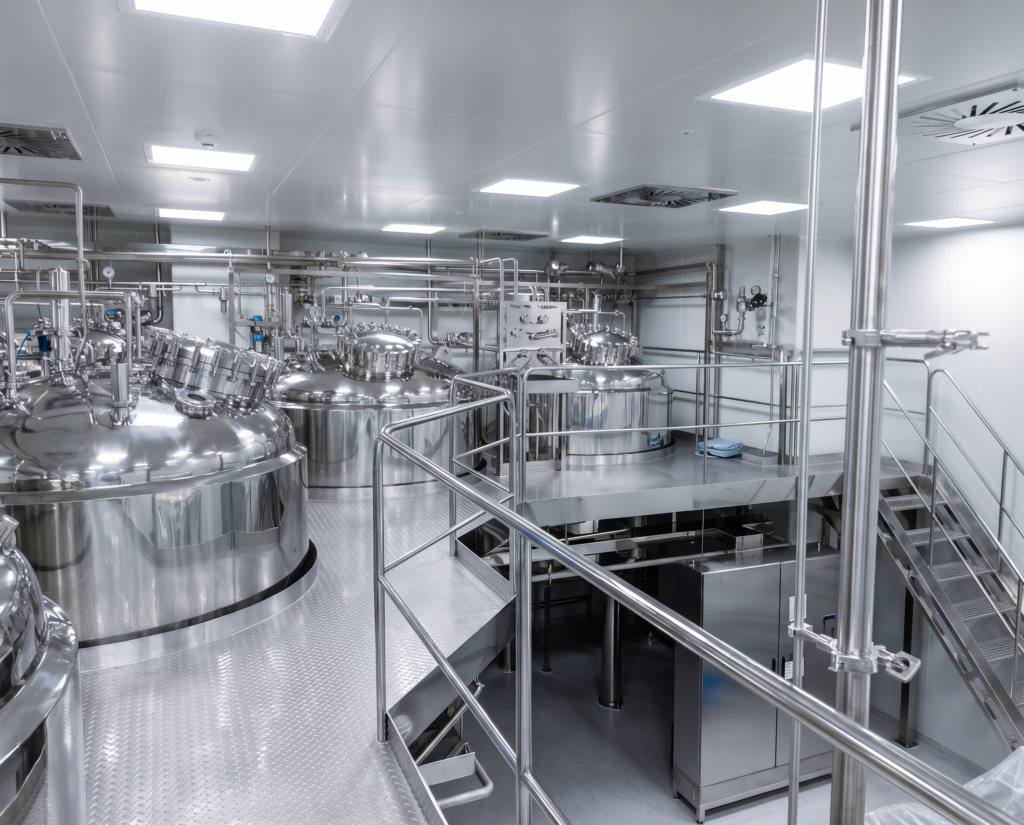
The supplied equipment included 13 process skids incorporating 48 tanks ranging from 800 to 7,000 L, alongside six cleaning skids incorporating 20 stainless-steel tanks of 1,800 L. The example demonstrates a delivered downstream process and cleaning-equipment scope. Read more about Boccard’s monoclonal-antibody production-unit case here.
Want to learn more about our solutions for
Pharma & Biotech?
Key points
Monoclonal antibodies are designed to bind specific biological targets, with applications of bispecific antibodies and antibody-drug conjugates including cancer treatment and the management of severe asthma.
Industrial production connects cell culture with antibody recovery and purification and increasing output from bioreactors can therefore place greater demands on downstream capacity.
Product quality and viral safety require controls throughout the manufacturing process, including assessment of the cell line, raw materials and viral clearance.
In a South Korean mAb project, Boccard supplied equipment for 2 downstream production units , including 13 process skids with 48 tanks and 6 cleaning skids with 20 stainless-steel tanks
scope of work, EQUIPMENT AND SERVICES SUPPLIED
- Engineering & prefabrication: Studies, design, project management and procurement for two downstream monoclonal-antibody production units.
- Process equipment: 13 process skids, incorporating 48 tanks ranging from 800 to 7,000 L, with associated platforms.
- Cleaning equipment: 6 cleaning skids, incorporating 20 stainless-steel tanks of 1,800 L, plus 4 plastic tanks for acid and soda storage.
- Construction and commissioning: A Korean partner constructed the installation using Boccard’s plans; Boccard’s teams carried out on-site commissioning.
You have a project ?
Our Customers
They trust us